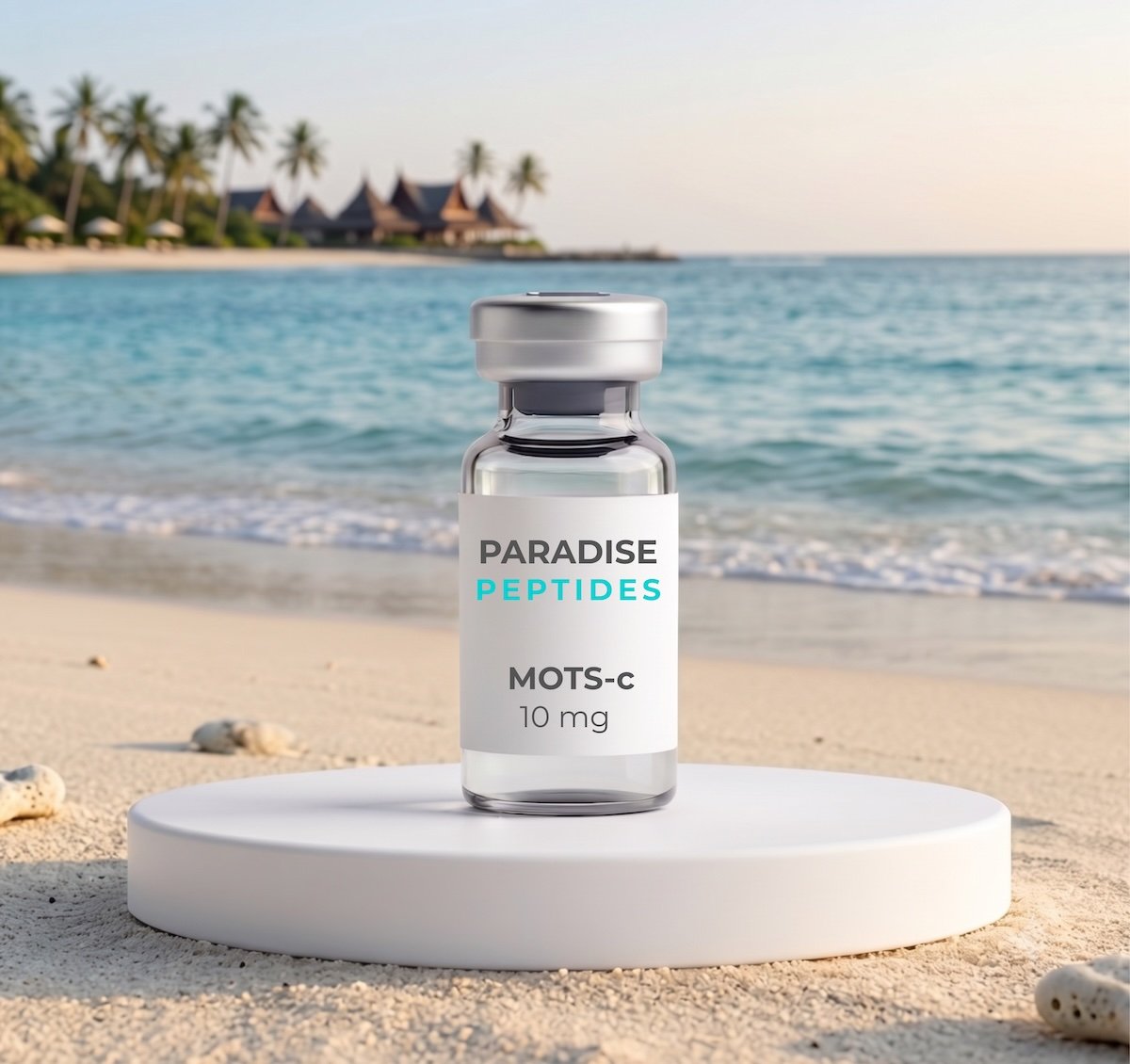
MOTS-c Paradise Peptides
🔜 Coming Soon

MOTS-c

A mitochondrial-derived peptide, encoded in mitochondrial DNA. Studied as a metabolic exercise mimetic — insulin sensitivity, energy regulation, longevity research.

≥99%
Purity
16
Amino Acids
Jul 2026
FDA PCAC Review
Select size
Contact us for pricing
Email Us to Order
Fast shipping across Southeast Asia · Research purposes only
The Science

What is MOTS-c?

MOTS-c is a 16-amino-acid peptide with a genuinely unusual origin: it's encoded within the 12S rRNA region of mitochondrial DNA, not the cell's nuclear genome. Most signalling peptides — everything else in this catalog — come from nuclear genes. MOTS-c is one of a small family of mitochondrial-derived peptides (MDPs), discovered by Changhan David Lee's lab at the University of Southern California in 2015. Its mitochondrial origin is central to its proposed biology: a retrograde stress signal that communicates the cell's metabolic state from the mitochondria outward to the nucleus and other tissues.

MOTS-c behaves in research as a metabolic "exercise mimetic" — it's naturally upregulated during physical exercise, translocates to the cell nucleus under metabolic stress, and activates AMPK-pathway genes involved in energy regulation and stress adaptation. That exercise-linked biology is exactly why WADA added it to the Prohibited List in 2024, under the same section that governs other performance-enhancing metabolic modulators.

The honest evidence picture: preclinical data (rodent and cell studies) is genuinely strong — improved insulin sensitivity, reduced obesity markers, diabetes prevention effects, and anti-aging signals across multiple animal models. Human data is thinner. The most relevant human-adjacent data point comes from CB4211, a MOTS-c analog developed by CohBar, which showed safety and reduced liver fat markers (ALT and AST both down double digits) in a Phase 1 trial in obese subjects with fatty liver — but CohBar's Phase 2 development was subsequently discontinued, and no MOTS-c-based drug has since advanced further in the clinical pipeline.

16
Amino acids
Encoded in mitochondrial DNA (12S rRNA region) — not nuclear DNA
2015
Discovered
USC lab of Changhan David Lee — one of the first identified mitochondrial-derived peptides
Jul 23–24
2026 FDA PCAC review
Formal committee review of MOTS-c for obesity and osteoporosis indications
Mechanism of Action

How MOTS-c works

MOTS-c's mechanism is genuinely distinct from every GH-axis or repair peptide in this catalog — it operates through cellular energy-sensing machinery rather than a hormone receptor cascade.

AMPK Pathway Activation
MOTS-c activates AMPK (AMP-activated protein kinase) — the cell's central energy-sensing switch, the same pathway activated by exercise and caloric restriction. This is the core of its "exercise mimetic" research reputation and the reason WADA classifies it alongside other AMPK-activating performance substances.
→ Cellular energy-sensing activation, exercise-like signalling
🔄
Mitochondrial-to-Nuclear Retrograde Signalling
Under metabolic stress, MOTS-c translocates into the cell nucleus, where it's proposed to modulate gene expression for stress adaptation and metabolic homeostasis — a direct communication channel from mitochondria to the nuclear genome, an unusual signalling architecture unique to the MDP family.
→ Mitochondrial stress state communicated to the nucleus
🩸
Insulin Sensitivity Modulation
Preclinical models show MOTS-c improves insulin sensitivity and glucose handling — a related mitochondrial-derived peptide from the same family, SHLP2, has been separately demonstrated to act as both a central and peripheral insulin sensitizer, supporting the broader hypothesis that MDPs coordinate metabolic adaptation.
→ Improved glucose handling in preclinical models
Research Areas

Where the evidence actually stands

MOTS-c's research profile splits cleanly into strong preclinical signal and a much thinner human evidence base — worth stating plainly rather than blurring the two together.

💪
Metabolic & Insulin Sensitivity Research
The primary research interest — animal studies show improved insulin sensitivity, reduced obesity markers, and diabetes-prevention effects. This is the mechanistic basis for the July 2026 FDA PCAC review specifically considering MOTS-c for obesity indications.
🏃
Exercise Capacity Research
Because MOTS-c is naturally upregulated during exercise and mimics several of exercise's metabolic signalling effects, it's studied as a potential "exercise in a vial" research candidate — though delivery and translation to human application remain active challenges.
🦴
Bone Health Research (emerging)
The same July 2026 PCAC review is also considering MOTS-c for osteoporosis — an emerging research angle beyond its original metabolic framing, reflecting growing interest in mitochondrial function's role in bone density maintenance.
⚠️
The Human Evidence Gap, Stated Plainly
No completed Phase 2 or Phase 3 human trial exists for MOTS-c itself. The closest human data point — CohBar's CB4211 analog — showed Phase 1 safety and promising liver fat marker improvements, but that specific development program was subsequently discontinued. Reliable delivery systems for mitochondrial-derived peptides generally remain a recognised translational barrier.
2026 Regulatory Update

The July 2026 FDA review that will shape MOTS-c's future

⚖️
April 2026 — Removed from FDA Category 2
MOTS-c is one of 12 peptides the FDA removed from its Section 503A Category 2 bulk drug substance list in April 2026. As with the other compounds affected by this reorganization, removal from Category 2 doesn't automatically create a lawful compounding pathway — it opens the door to formal review, which is exactly what's scheduled next.
📋
July 23–24, 2026 — Formal PCAC Review
MOTS-c is one of seven peptides scheduled for Pharmacy Compounding Advisory Committee review on July 23–24, 2026, with the committee specifically evaluating it for obesity and osteoporosis indications for potential Section 503A Bulk Drug Substances List inclusion. FDA staff briefing documents reportedly recommend caution, citing limited human safety and effectiveness data — worth knowing going in, since PCAC's late-2024 review of CJC-1295, Ipamorelin, and AOD-9604 resulted in all three being voted down for Category 1 inclusion.
🏅
WADA Status — Banned Since 2024
WADA added MOTS-c to the Prohibited List in 2024 under Section S0 (non-approved substances), specifically citing its AMPK-activating, exercise-mimetic properties. All Paradise Peptides products are supplied for research purposes only.
Stack Synergies

How MOTS-c works with other compounds

MOTS-c's stacking logic is different from the GHRH-family pairings elsewhere in this catalog — it's not about receptor complementarity, but about combining distinct mitochondrial and metabolic mechanisms for broader longevity research coverage.

🔬 MOTS-c + Humanin — The Mitochondrial-Derived Peptide Pairing

Both MOTS-c and Humanin belong to the same unusual family — peptides encoded in mitochondrial DNA rather than the nuclear genome — but they act through distinct mechanisms, which is the basis for pairing them in mitochondrial longevity research.

Why they're discussed together: both are mitochondrial-derived peptides studied in longevity research, but MOTS-c's research focus is metabolic/energy signalling while Humanin's is cytoprotection and cell survival — complementary angles on mitochondrial health rather than the same mechanism twice.

🔗 MOTS-c + NAD+ — Mitochondrial Energy Stack

A second common pairing in mitochondrial longevity research: NAD+ is the coenzyme substrate mitochondria need for energy metabolism and DNA repair, while MOTS-c is a signalling peptide that modulates how cells respond to metabolic stress. One supplies raw material for mitochondrial function, the other modulates the signalling around it — a substrate-plus-signal combination rather than two compounds competing for the same job.

Research Protocol

Suggested research protocol

1
Reconstitution
Add 2ml bacteriostatic water to a 5mg vial for a concentration of 2.5mg/ml. Inject BAC water slowly down the side of the vial, never directly onto the powder. Gently swirl; never shake. Use the Paradise Peptides reconstitution calculator for exact syringe marks.
2
Dose range studied
Most research protocols cite 5–10mg per week, commonly split across 2–3 injections. Given the limited human dosing data, protocols vary more here than for better-established compounds.
3
Frequency & timing
Commonly dosed subcutaneously 2–3x per week rather than daily. Some research protocols time injections around exercise sessions, consistent with its studied role as an exercise-linked metabolic signal.
4
Storage
Unreconstituted: −20°C. Reconstituted: +4°C refrigerated, use within 2–3 weeks for best stability. Keep away from light and heat. Do not freeze the reconstituted solution.
FAQ

Frequently asked questions

Is MOTS-c FDA-approved?
No. MOTS-c has no FDA approval for any indication, and there is no completed Phase 2 or Phase 3 human efficacy trial in the published literature. It's currently under formal FDA Pharmacy Compounding Advisory Committee review, scheduled for July 23–24, 2026, which will help determine its future compounding status.
What makes MOTS-c different from other peptides?
It's genuinely unusual biology — MOTS-c is encoded within mitochondrial DNA rather than the cell's nuclear genome, one of only a handful of known mitochondrial-derived peptides. Most peptides in research use, including everything else in this catalog, come from nuclear genes.
Should I stack MOTS-c with Humanin or NAD+?
Both are reasonable, complementary pairings rather than redundant ones. MOTS-c + Humanin combines two mitochondrial-derived peptides with distinct mechanisms (metabolic signalling vs. cytoprotection). MOTS-c + NAD+ combines a signalling peptide with the coenzyme substrate mitochondria actually need for energy production — different roles, not competing ones.
What is included in the kit?
For local shipping within the Philippines, every MOTS-c order includes a complete research kit: a drawing syringe for reconstitution, insulin syringes for injection, alcohol pads, bacteriostatic water, and secure discreet packaging. For international orders, the kit isn't included by default (some items don't ship well across borders) — the peptide vial ships on its own, and you'll want your own reconstitution supplies on hand. Email us if you're unsure what you'll need.
Can I buy just the peptide vial without the kit?
Yes — if you already have your own supplies, just let us know via email and we'll accommodate you. Email us →
Where does Paradise Peptides ship?
Paradise Peptides is based in Cebu and supplies MOTS-c as a research compound across Southeast Asia. Enquiries and orders are handled via email. Shipping is discreet. All products are for research purposes only.
How do I calculate my dose?
Use the free Paradise Peptides reconstitution calculator. Enter your vial size, how much BAC water you added, and your desired dose. The calculator gives you the exact syringe mark — no maths required.
References

Research sources

Lee C, et al. Discovery and characterization of MOTS-c, a mitochondrial-derived peptide. University of Southern California, 2015.
Cobb LJ, Lee C, Mehta H, Cohen P, et al. Naturally occurring mitochondrial-derived peptides SHLP1-6 — identification and characterization. Aging (Albany NY). 2016.
CohBar Inc. CB4211 Phase 1 clinical trial results — safety and liver fat marker reduction in obese subjects with fatty liver disease. Phase 2 development subsequently discontinued.
U.S. Food & Drug Administration. Section 503A bulk drug substance list reorganization, April 2026 — MOTS-c among 12 peptides removed from Category 2. Pharmacy Compounding Advisory Committee review scheduled July 23–24, 2026.
World Anti-Doping Agency (WADA). Prohibited List, Section S0 — MOTS-c added 2024 as an AMPK-activating, exercise-mimetic substance.

MOTS-c's human clinical evidence base is thin relative to its preclinical promise — stated plainly rather than overstated. The closest human data (CB4211) is a related analog compound, not MOTS-c itself.
Complete your protocol

Works well with